
Could Dementia Hold a Clue to Dyslexia?
2026-07-11
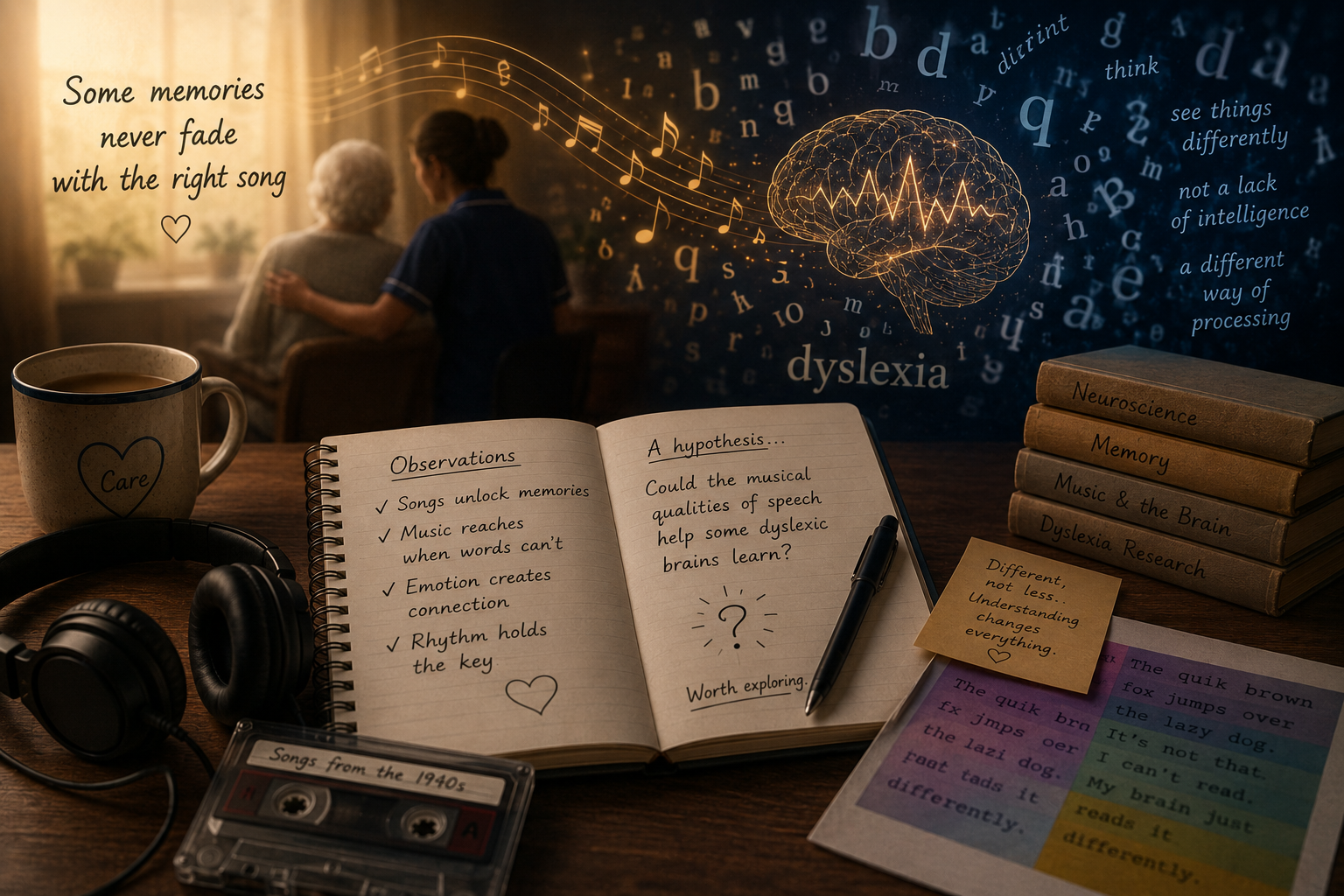
From Dementia Care to Dyslexia: How Two Seemingly Unrelated Experiences Led Me to forming an evidence-informed hypothesis inspired by years of dementia care, my own dyslexia, and emerging neuroscience.
For many years, I believed dyslexia was simply something that made reading and writing harder.
Looking back, I no longer see it that way.
While I struggled to decode written words, my mind was constantly searching for patterns, connections and explanations. It wasn’t language that my brain excelled at; it was seeing relationships between experiences that, at first glance, seemed completely unrelated.
This is one of those stories.
It is simply a hypothesis, built from lived experience, careful observation and existing neuroscience, which I hope may encourage further research.
An unexpected lesson from dementia care
I began working in care at the age of sixteen.
Over the following years I worked in residential homes, nursing homes, domiciliary care and as a self-employed carer. Caring for people became much more than a job to me. I genuinely loved it.
One area fascinated me more than any other: dementia and Alzheimer’s disease.
At the time, I had no idea I was dyslexic. I also now recognise many lifelong traits that have led to autism and ADHD referrals for assessments.
As an undiagnosed dyslexic, I didn’t have the scientific vocabulary to explain why I found it so fascinating. I simply couldn’t stop thinking about it.
I would go home wondering how memory worked.
Why did someone forget what happened this morning but remember events from decades earlier?
Why did recent memories seem to disappear before childhood memories? Much like a filing cabinet, where the newest files disappeared first, while the oldest remained.
As dementia progressed, I often watched personalities gradually change. Adults who had lived long, independent lives sometimes became increasingly childlike in the way they communicated and interacted with the world.
Then I witnessed something that stayed with me for years.
Some people had lost much of their language, memory and cognitive function.
Conversation had become incredibly difficult.
Yet when music from their younger years began playing—wartime songs, music from the 1930s and 1940s—they suddenly joined in.
Many could sing every word, perfectly in time with the music.
Sometimes they remembered entire songs despite struggling to hold a conversation.
As a young carer, I found this astonishing.
I didn’t understand why. But I never forgot it.
Throughout school, I was always the person struggling to learn. New barriers constantly appeared, and without understanding why, I developed my own ways of overcoming them. Looking back, those barriers may also have shaped the way my brain learned to solve problems and recognise patterns.
Fast forward several years.
I was twenty-seven years old.
I was trapped in an abusive relationship, raising my two daughters and struggling with my mental health.
At one point I faced a decision.
Should I return to my GP and simply increase my anxiety medication?
Or should I try changing something much deeper, even though I couldn’t yet identify the real cause of my struggles?
I chose college.
It was 2013.
I was significantly older than most of the students, overweight, lacking confidence and carrying years of self-doubt.
I enrolled on an acting course.
At the time, I had no idea I was dyslexic.
Like many undiagnosed adults, I believed my difficulties were evidence that I simply wasn’t intelligent enough.
I couldn’t explain why reading was exhausting.
I couldn’t explain why words seemed to move, blur or refuse to stay in my memory.
I now recognise many of those experiences as visual stress and dyslexia.
But back then, I had no language for any of it.
The moment everything changed
The acting course unexpectedly taught me something that had nothing to do with acting.
Actors learn about expression.
Rhythm.
Emotion.
Timing.
Voice.
Intonation.
As I experimented, I discovered something remarkable.
If I read my coursework in my own monotone yorkshire accent, very little stayed in my memory.
If I used the assistive technology recommended for dyslexic learners—a computer reading in a flat, robotic voice—the result was exactly the same. The information simply didn’t stay with me.
But if I read it aloud in another accent—Scottish, Belfast, Edinburgh, almost any expressive accent—or if I found somebody on YouTube reading the same material naturally and expressively, everything changed. These accents to me felt melodic in tone.
It wasn’t the accent itself that mattered. It was the rhythm, the rise and fall of the voice, the expression and the melody within the speech.
Could the musical qualities of speech—not just music itself—help some dyslexic brains encode information more effectively?
What if my brain wasn’t responding to language alone, but to the musicality within language?
The information seemed to come alive.
Instead of fighting to remember it, I absorbed it almost immediately.
It felt less like reading…
…and more like listening to music.
That discovery transformed the way I learned.
The connection my brain made
Years later, I realised my brain had quietly connected two completely different experiences.
One involved older adults living with dementia who could still access songs after much of their language had been lost.
The other involved an undiagnosed dyslexic adult who suddenly learned more effectively when language itself became more musical.
I began asking myself a question.
Could the musical qualities of speech—not just music itself—help some dyslexic brains encode information more effectively?
I don’t know.
But I think it is a question worth investigating.
What science tells us about dementia, music and memory
Modern neuroscience suggests that this phenomenon is real.
Researchers have found that musical memory is often remarkably well preserved in many people living with Alzheimer’s disease.
This does not mean music is stored in one separate “music centre” of the brain.
Instead, music activates widespread networks involving memory, emotion, movement, rhythm and auditory processing. Some of these networks appear to remain relatively preserved even as Alzheimer’s disease progresses.
Familiar songs can also trigger autobiographical memories and emotional responses, allowing people to recall lyrics or sing along even when everyday conversation has become extremely difficult.
Scientists are still investigating exactly why this happens, but the evidence consistently shows that music accesses the brain differently from ordinary spoken language.
What science tells us about dyslexia
Research into dyslexia has also become increasingly interesting.
Scientists have found that many dyslexic people process the rhythm, stress and melody of speech—known as prosody—differently from non-dyslexic readers.
Prosody includes changes in pitch, emphasis, timing and expression.
It is the difference between someone reading in a completely flat monotone voice and someone reading naturally with emotion and variation.
Researchers continue to investigate how prosody influences reading, language development and memory.
Although no research currently proves that listening to expressive accents improves learning in dyslexia, the existing evidence suggests this may be an area worth exploring.
My hypothesis
I am not suggesting that music cures dyslexia.
Nor am I suggest that expressive voices will help every dyslexic person.
What I am proposing is a hypothesis.
If melody and rhythm can help unlock memories in some people living with dementia…
Could the rhythmic and musical qualities of expressive speech help some dyslexic brains encode new information more effectively than flat, monotone speech?
Could the problem, for some of us, be not simply what we hear…
…but how we hear it?
I don’t know the answer.
I hope researchers will.
Looking back
For much of my life I believed I lacked intelligence.
That belief wasn’t created by my brain.
It was created by years of misunderstanding, inaccessible education and repeated messages that my difficulties reflected my ability.
Today I see things differently.
I don’t believe my dyslexia limited my thinking.
I believe it shaped it.
The barriers I faced forced me to develop different ways of understanding the world.
Those same barriers encouraged curiosity, pattern recognition and problem-solving.
They taught me to keep asking “why?”
This article may simply describe one dyslexic person’s experience.
Or perhaps it highlights a question that deserves scientific investigation.
Either way, if sharing my experiences encourages even one researcher to explore this idea further, then every struggle I experienced finding my own way of learning will have served a purpose.
Have you experienced something similar? If you’re dyslexic and find that expressive voices, accents, rhythm or melody help you learn, I’d love to hear from you. Your experiences could help shape future discussions and, perhaps one day, future research.
⸻
References
Alves, R. A., Reis, C., & Pinheiro, A. P. (2015). Prosody and reading in developmental dyslexia.
Clark, C. N., & Warren, J. D. (2015). Music, memory and mechanisms in Alzheimer’s disease. Brain, 138(8), 2122–2125.
Cuddy, L. L., Sikka, R., & Vanstone, A. (2015). Preservation of musical memory and engagement in healthy aging and Alzheimer’s disease.
Groussard, M., et al. (2019). Preservation of Musical Memory Throughout the Progression of Alzheimer’s Disease. Journal of Alzheimer’s Disease.
Mundy, I. R., & Wood, G. (2024). Prosody and Developmental Dyslexia: A Meta-analysis.
Peck, K. J., Girard, T. A., Russo, F. A., & Fiocco, A. J. (2016). Music and Memory in Alzheimer’s Disease and the Potential Underlying Mechanisms.